
Jetway Journal
146 hours of learning Italian with Pimsleur and Jetway
What 146 hours of focused Italian study with Pimsleur, Jetway, comprehensible input, and speaking practice made possible on a trip through Italy.
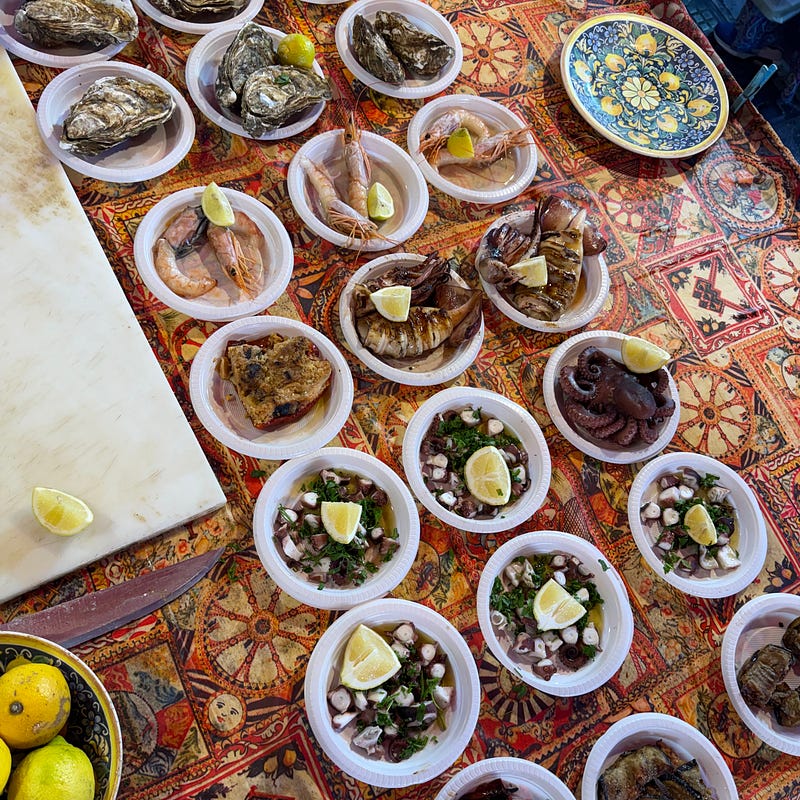
As anyone who has watched Stanley Tucci’s Searching for Italy can attest, Italy has everything: great culture, great food, great wine, interesting people. So, last year, my wife and I decided to plan a trip to Italy. Which of course meant I was going to learn Italian. Perché no?
But how far can you get on a limited time budget? Can you actually learn a meaningful amount 4–6 months before a trip? This seemed like a question worth answering, but more so, learning Italian seemed like it would be fun.
Bootstrapping with Pimsleur
I selected Pimsleur to help me bootstrap basic grammar and vocabulary. For those of you who are a bit older, you may remember the cassettes with the audio lessons. If you’re new to Pimsleur, it is primarily an audio course. Each lesson features a lot of hypothetical conversations where you’re trying to translate and say the appropriate phrase before you hear it from the native speaker.
I was very impressed by Pimsleur.
- It gets you talking from day 1, and speaking has been proven to improve your learning and retention (the “production effect”).
- It introduces you to the most important grammar topics quickly, giving you a foundation to self-teach a much wider array of vocabulary.
- Spaced repetition (SRS) is essentially built into the lessons, ensuring you remember previous lessons easily
- I have to drive a lot, so the audio format was perfect for me
There were some challenges as well:
- Pimsleur doesn’t stop to explain grammar. If I hadn’t studied French or Spanish previously, I would have been lost with the conditional/subjunctive tenses. You’ll absolutely want to augment your studies when you get to Levels 4+.
- Occasionally it gives you the approximate translation instead of the literal translation. I strongly dislike this because it is better to just start thinking about expressions the same way an Italian would. A very simple example being, “si accomodi” which can mean “have a seat” or “come in”, but literally means “make yourself comfortable”. (This is even more confusing in Mandarin which I am doing now)
- The app wasn’t my favorite, but that’s another story.
Total time: ~75 hours over ~25 weeks.
Pimlseur is not the first app I’ve used to learn a language. I used Duolingo back in the day to learn French and German. I found Pimlseur to be MUCH more efficient. You start talking and forming sentences immediately. No crap like “the horse ate the cheese”.
I also evaluated Language Transfer for Italian and got nowhere. I was a bit confused why there is so much love for it. The guy talks a lot and you spend more time listening the speaking.
Jetway for SRS + Comprehensible Input
About 2/3rds of the way through Pimsleur, I started to broaden my focus. With only 2 months left before my trip and with a busy work schedule, time efficiency was key, so I dove into Jetway.
Jetway is based on “skill-based spaced repetition.” The idea is that you can combine speaking, active recall, and spaced repetition to learn more efficiently through studying skills, not vocabulary.
With traditional spaced repetition tools, you might see a single word on a card, e.g. “saporito” with the answer, “tasty” on the back. With Jetway, you practice the broader skill of “describing food at a restaurant” with the word “saporito”. When it comes time to learn or review, Jetway generates new sentence, such as “Questo piatto è davvero _ [hint: tasty].” Your job was not just to recognize it, but to produce it out loud while actively recalling the word.
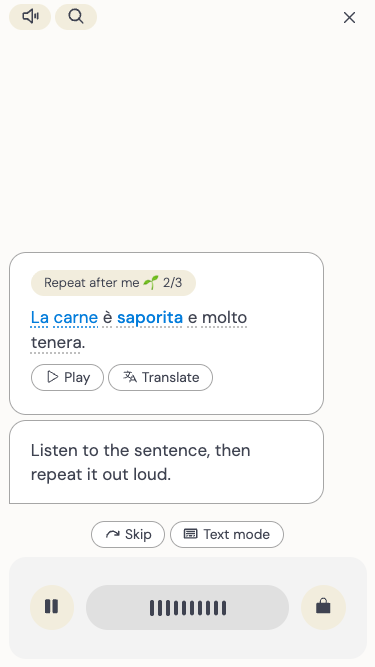
Learning the concept of “saporito” through a speaking exercise
This is more effective than traditional spaced repetition for several reasons:
- You have to actively recall the word rather than just recognize it.
- You have to say it out loud, building confidence and improving retention
- The sentence changes from review to review, so you learn how to use the word in context rather than memorizing one fixed example.
- Jetway can mix skills together. So if you are practicing both restaurant language and “vorrei” (I would like), I might get something like “Vorrei un piatto davvero [hint: tasty].” Again this improves efficiency and retention.
Because it exposed me to so many different contexts and forced me to produce sentences, it felt more like real language use than just memorizing cards.
SRS time: 50 hours (~20 mins/day)
Comprehensible input
For input, I focused mainly on watching YouTube shorts which were recommended to me by Jetway. As I watched videos, I would translate words I didn’t know by clicking on them and adding them to my study queue.
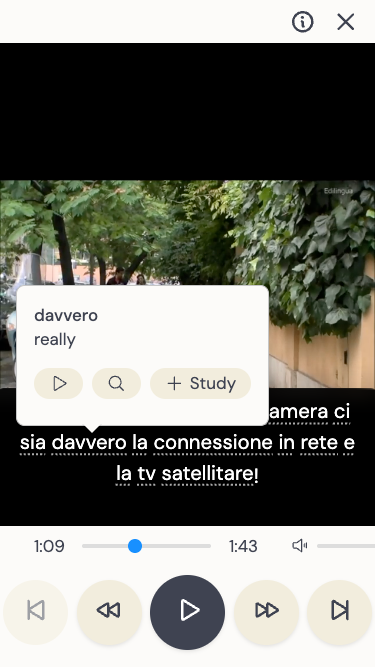
I also watched couple series with English subtitles. Detective Montalban being the main one(anyone here using Mhz Choice?!). I’m not sure how effective this was given how advanced the speaking was, but it was enjoyable at least!
More useful was the Italian reader I bought for my Kindle. For words I didn’t know, I would translate on my Kindle and highlight them. Then I would log them into the notes in Jetway, which would turn them into skills to study in my queue.
Input time: 20 hours (~10 mins/day)
Speaking practice
I practiced very little traditional output: I never practiced with a tutor, only chatted with Jetway/ChatGPT a few times. The bet was that combining speaking with spaced repetition would give me the foundation I needed in the real world.
The trip and results
I was pleasantly surprised with how far I was able to get with Italian in such a short amount of time. I had some real successes:
- Speaking/pronunciation confidence: When I knew the words, I was confident and people spoke back to me in Italian!
- I easily navigated restaurants, menus, wine lists
- I understood the tips given by our Roman taxi cab driver on how to get around
- Chatted with the adorable mother of my AirBnB host who brought us these Sicilian donut things 🍩
- Talked to a group of drunk old Italians on the street in Ragusa and took their photo
- Translated (badly) for English speakers during wine tastings on Mt Etna when the staff didn’t understand
- Navigated highways, cities, etc. without issues
To put this all in perspective, I am at the point where I am just starting to be able to follow along to the EasyItalian podcast (keep up the great work guys!). So I guess high A2/low B1 if you’re into CEFR levels?
I didn’t nail everything though. Some of my misses included:
- Not enough time spent studying. 146 hours is simply not enough. With another 100 hours I would have been at a totally different level. But, life and work interfered. 🤷
- I seriously under-practiced formal conjugations and pronouns, and I was unsure of Italian protocol about when to use them.
- Limited vocabulary of expressions and connectors, things like “comunque” (anyway), “infatti” (in fact), “anzi” (rather/on the contrary) that you naturally want to do.
Learning Italian has been super fun. I’m not “fluent” by any means, but I’m happy with here I ended up with the time I put in. For others I hope this is a useful benchmark of where ~150 hours of focused study can get you, and some ideas for how to structure your learning.
Most importantly, this journey enabled some great experiences. And speaking Italian is così divertente!